2. How common is CEP?
CEP is extremely rare. As it is so rare, the exact number of people affected by CEP is not clear. It is estimated that about 1 in every 2 – 3 million people are affected by CEP. CEP can affect males and females equally, and any ethnic group.
3. What are the features of CEP?
Individuals with CEP may not have all the features described here, and they may have big differences in severity. The condition usually shows itself soon after birth or in early childhood, but sometimes it does not show until adolescence or early adulthood.
- Red urine is usually the first sign noticed in newborn babies with CEP. This is due to the large amount of porphyrin passed in the urine. The intensity of the redness of the urine can vary from day to day.
- The skin is very sensitive to light, especially direct sunlight or intense artificial light, such as the very bright light sometimes used to treat babies with jaundice. This causes the skin to become fragile and blister or ulcerate. This most commonly happens at sun-exposed sites, for example the backs of the hands, the face, ears, nose and scalp. The skin may take longer to heal after injury or blistering, and is more prone to infection.
- Repeated blisters, wounds and ulcers can cause severe scarring, bald patches on the scalp, and secondary infections of the skin and bone. In extreme cases, severe damage can result in the loss of facial features (nose, ear and lids) and digits.
- Some individuals may develop darkening of sun-exposed skin.
- Eyes may also be sensitive to bright sunlight or artificial light, which can cause ulcers and scarring of the eyes. With time some patients lose their eyelashes, making their eyes prone to irritation from dust and other small particles.
- Anaemia (low haemoglobin), which varies in severity, is another feature of CEP. A specific form of anaemia (haemolytic anaemia) can develop because porphyrins damage red blood cells faster than they can be produced. The symptoms of anaemia include feeling tired, short of breath following minimal exertion and looking pale. A blood test will confirm the presence of anaemia.
- The spleen can gradually become bigger and cause worsening of the anaemia, and a reduction in the number of platelets (the blood cells that help to form blood clots to stop bleeding) and white cells (the blood cells that fight infections) in the blood leading to increased risk of bleeding (such as repeated nose bleeds) and infections.
- Teeth are discoloured by porphyrins causing them to appear reddish brown, especially the milk teeth.
- CEP can occasionally cause thinning of the bones (osteoporosis). Osteoporosis can lead to broken bones (fractures) following minimal injury.
- Excess body hair may develop, especially on the face and backs of the hands.
4. How is CEP inherited?
The low UROS enzyme activity in CEP is due to alterations (mutations) in the UROS gene that codes this enzyme. Everyone has two copies of every gene, one inherited from their mother, and one from their father. To develop CEP, an individual must inherit one altered copy of the UROS gene from each parent, as shown in the diagram. This pattern of inheritance is called “autosomal recessive”.
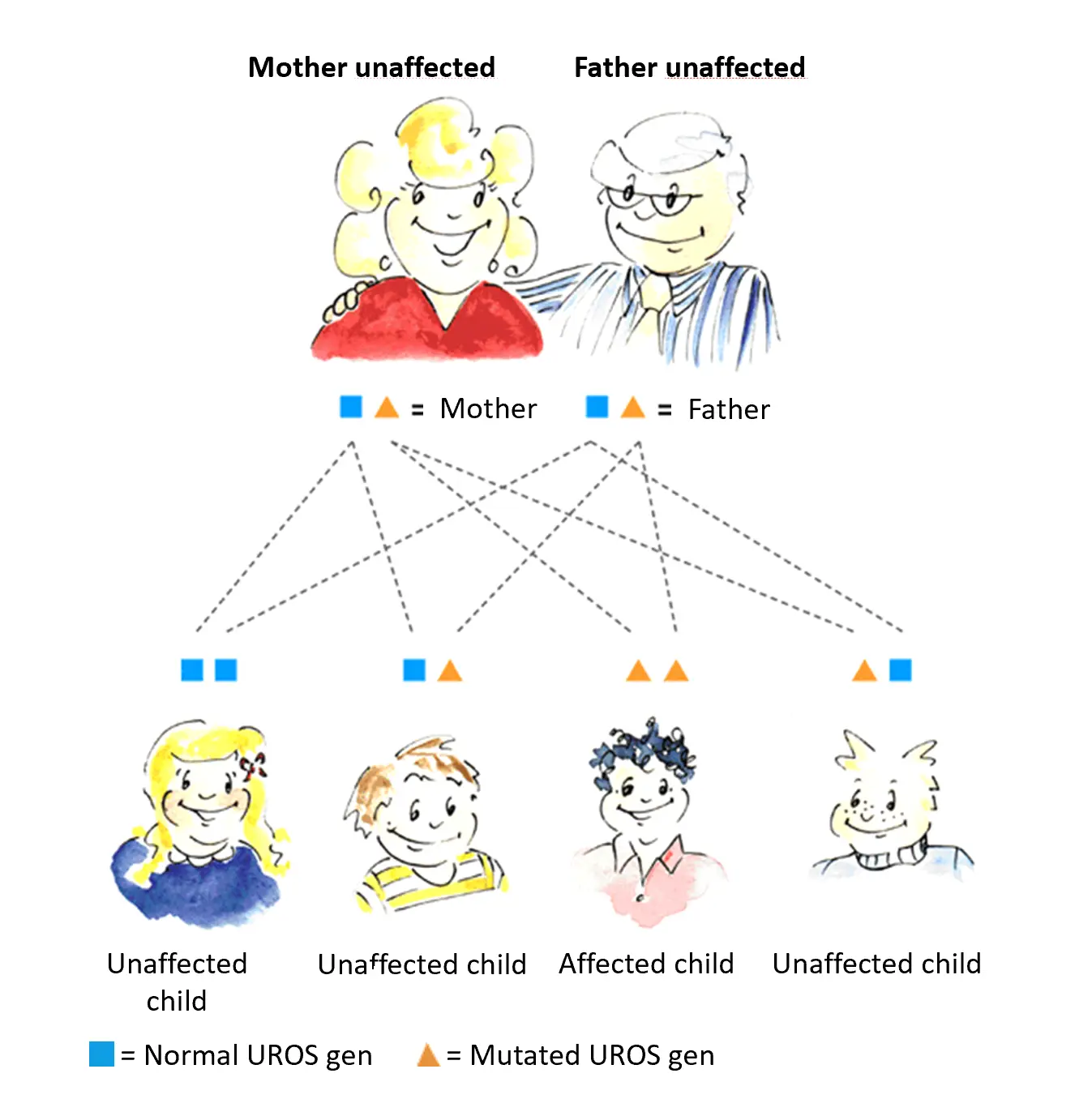
© Illustrations copyrighted Clare Hollest
Parents, who have each passed on an altered gene, do not have the disease because they also have one ‘normal’ gene. People who carry one altered gene and one normal gene are called “carriers”. Carriers do not usually have CEP because one working copy of the gene provides enough enzyme activity.
When both mother and father are carriers, each of their (unborn) children will have a 1 in 4 risk of having CEP and a 1 in 2 risk of being a carrier. The risk that the child of a carrier will have CEP is extremely low, because their partner is very unlikely to be a carrier (the gene variation that causes CEP is very rare in the general population), unless he/she is a close relative. All the children of someone with CEP will be carriers but are very unlikely to have CEP.
5. How is CEP diagnosed?
CEP may be suspected in children (or rarely adults) who present with the features described above. The diagnosis is confirmed by measuring porphyrin levels in the individual’s blood, urine and faeces. These samples need to be protected from light until they are analyzed. A blood sample may also be taken to look for genetic variants.
6. Can CEP be diagnosed in pregnancy?
Testing for CEP during pregnancy is not offered routinely. However, CEP can be diagnosed in pregnancy in families where there is already a child with CEP. In this situation, a test called “amniocentesis” is carried out at about 16 weeks of pregnancy. Alternatively, another test called “chorionic villus sampling” is carried out at about 12 weeks of pregnancy to collect blood cells from the placenta arising from the baby. These cells are then checked for the UROS gene mutations causing CEP.
7. Is there a cure for CEP?
At present, the only treatment that has the potential to cure CEP is a bone marrow transplant (BMT). This involves transplanting healthy bone marrow from another person (the donor) to that of the person with CEP (the recipient). Following successful BMT, the features of CEP such as photosensitivity and anaemia will resolve. However, the scarring from previous damage to the skin is permanent. For BMT to succeed, the bone marrow of the donor needs to be a good match with the recipient. BMT is a high-risk treatment where powerful treatments to suppress the recipient’s immune system are initially needed to prevent rejection. Because of these risks, BMT is only advised for very severely affected individuals who have a matched bone marrow donor.
8. How can CEP be managed?
The treatment of CEP aims to prevent damage to the skin and eyes, manage complications, and improve quality of life. Depending on the severity of your condition, some or all of the following measures may be recommended:
Protecting your skin from light and general measures
- Protecting your skin from sunlight and bright artificial light is the most important part of managing CEP. Clothing should cover as much skin as possible and may include gloves, long sleeves, high collars, long trousers, a scarf and a broad-brimmed hat.
- Conventional sunscreens (which block ultraviolet (UV) light) are not effective in CEP because the photosensitivity is caused by visible light. Reflectant sunscreens designed to block visible light, or sunscreens containing zinc oxide, may provide some protection.
- Curtains or blinds at home, school or work may help reduce visible light exposure. Specialist window films that reduce visible light can also be fitted to buildings or vehicles and are generally more effective than standard UV-protective films. If fitting window film to a vehicle, check that it complies with your country’s driving regulations.
- Tinted wrap-around sunglasses are recommended to protect the eyes from visible light. Regular review by an ophthalmologist (eye specialist) may also be needed.
- Vitamin D is mainly produced in sun exposed skin and individuals who avoid the sun often develop vitamin D deficiency. All CEP patients should take vitamin D at the recommended dose.
Looking after your skin
- Skin exposed to light should be protected from minor knocks and injuries, which can lead to blistering and long-term scarring. Keeping the skin well moisturised and wearing protective gloves can help.
- Skin ulcers and broken blisters should be kept clean, dressed appropriately and treated promptly if they become infected.
- Repeated scarring, particularly affecting the fingers, can reduce movement over time. Regular gentle hand exercises may help maintain flexibility and reduce stiffness. Some people may benefit from advice from an occupational therapist.
Treating complications
- People with severe anaemia may require blood transfusions. However, repeated transfusions can lead to iron overload, which may need treatment with medication. If the spleen becomes enlarged and worsens the anaemia, surgery to remove the spleen may sometimes be recommended.
- If osteoporosis (thinning of the bones) develops, treatment with medication may be recommended to reduce the risk of fractures.
- Good oral hygiene is important to help prevent tooth decay. If scarring around the mouth makes brushing difficult, a soft children’s toothbrush or an electric toothbrush may be easier to use and less likely to damage the gums.
Most people with CEP are cared for by a specialist team including dermatologists, haematologists and porphyria specialists. Together they can help manage symptoms, monitor for complications and support the best possible quality of life.
9. Will there be new treatments available for CEP in the future?
Research into new treatments for CEP is advancing rapidly. Alongside studies investigating whether making CEP patients mildly iron deficient can lower porphyrin production in selected patients, new medicines known as pharmacological chaperones are being developed to stabilise the faulty UROS enzyme and improve its activity. One promising potential treatment, ATL-001 (Ciclopirox), has successfully completed early safety studies and is currently being evaluated in people with CEP to assess whether it can reduce photosensitivity and improve symptoms.
Gene therapy is also being actively investigated, with the aim of correcting the underlying genetic cause of the condition. Although these approaches remain experimental, they represent some of the most promising developments in CEP treatment to date.
10. Can certain medications make CEP worse?
CEP is an erythropoietic porphyria which differs from acute porphyrias which can be made worse by certain medications. CEP is not made worse by any of these medications. Therefore, unless the person is allergic to a medication for any other reason, individuals with CEP can take any medication that their health requires.
11. What other precautions do CEP patients need to take?
If an individual with CEP is having an operation, bright operating lights may expose internal tissues to high levels of visible light. In people with CEP, this could cause light-related tissue damage of internal organs. The surgical team should therefore be informed of the diagnosis in advance so that appropriate light filters or other protective measures can be used.
12. Where can I get more information about CEP?
As CEP is a very rare condition, most general practitioners will have little experience of the condition. Dermatologists and haematologists see most people with CEP and usually ask advice from a porphyria specialist centre. If you are concerned about the likelihood of passing the condition onto your children, you may be referred to a geneticist or porphyria specialist centre for information.
The content on this website is based on a consensus agreed by Ipnet partners. Patient organisations provide reliable information, practical advice and opportunities to connect with other people and families affected by CEP. Porphyria patient groups are listed on the International Porphyria Network website and the Global Porphyria Advocacy Coalition (GPAC) website.
Revised: June 2026
